
CertiDocsThe practical guide
Foreign judgment: recognition or exequatur in Belgium
Recognising a foreign decision and enforcing it are different questions. The regime depends on country, subject and applicable rules; a full translation is not automatic.
Understand the processWhat is exequatur?
Link to this sectionExequatur concerns a declaration of enforceability where one is still required. It is distinct from recognition: Article 22 of the Belgian Code of Private International Law generally allows a foreign decision to be recognised without the enforceability procedure. Seizure or other coercion, civil-status updates and simple reliance on a judgment are different outcomes.
When is exequatur not necessary?
Link to this sectionThe applicable instrument depends on subject matter. Brussels I bis covers many EU civil and commercial decisions. Brussels IIb covers divorce, legal separation, marriage annulment and parental responsibility, but excludes maintenance obligations, which are addressed notably by Regulation 4/2009. Outside the EU, the Belgian Code or a convention may apply: identify the intended use and governing instrument first.
Before translation: identify the intended legal effect #
Recognition and enforcement of a decision are distinct questions. The applicable rules depend, among other things, on the subject matter and origin of the decision. Confirm the procedure with the professional handling the case before ordering translations.
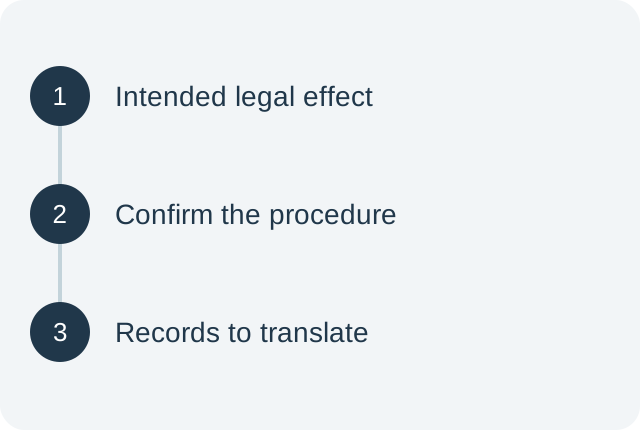
Preparation advice from CertiDocs #
Fictional example: one person wants to update a civil-status record; another wants to recover a sum awarded by a court. They should not automatically order the same translation package. Give the adviser handling the procedure the precise objective.
- Prepare the country, court, decision date and subject matter. Ask which records establish service or finality when those elements are required.
- Confirm which pages, certificates and annexes require translation. An accurate translation cannot replace a missing record or legal assessment.
Prepare the next step
Documents to prepare
- Copy of the decision meeting the applicable requirements
- EU certificate or translation of requested parts, depending on regime
- Authentication checked rather than an assumed apostille
- Proof of service on the defendant, if required
- Evidence of enforceability or finality, as required by the applicable rules
- Court, procedure and representation confirmed
Steps to follow
Check if exequatur is necessary
First define the outcome: recognition, civil-status use or forced enforcement. Then identify the country, subject matter and applicable regulation, convention or Belgian Code.
Determine what needs translation
Check whether the prescribed certificate is sufficient and which parts the authority must read. Under Brussels IIb, a translation of the decision may be required where the authority cannot proceed without it; that is not a blanket full-translation rule.
Compile the court file
Gather the decision, any required proof of authenticity and enforceability or finality, the certificate prescribed by the applicable instrument and requested translations. Confirm the application form and representation with the court or legal counsel.
Follow the applicable procedure, with exequatur if required
If a declaration of enforceability is required, follow the procedure before the competent court. If the applicable regime dispenses with exequatur, follow the recognition or enforcement formalities for your intended use. Confirm the documents and possible grounds for refusal with the professional handling the case.
Good to know
Guides
On the same topic
Other steps to prepare. Divorce and civil status.
Foreign divorce with a child: custody, residence and parental responsibility in Belgium
After a foreign divorce with a child, what Belgium actually checks: parental responsibility, the child's residence, parental agreements, the judgment and translation.
Move abroad with a child after divorce in Belgium
What must be locked down before moving abroad with a child after divorce: parental responsibility, agreement, useful judgment and translation of the records that matter.
Divorce granted outside the EU: recognition in Belgium
Non-EU divorce in Belgium: recognition, authentic copies, default judgments, refusal grounds, remedies and Article 57 conditions.
For your application
Related documents
Common translations
Budget
Prepare your translation request
Choose the document type in the form to see your fixed price.
One fixed price per complete document, regardless of page count. Confirm the price before submitting. See all prices
Frequently asked questions
+−What exactly is exequatur?
+−Does an EU divorce judgment require exequatur?
+−Does the foreign judgment need an apostille?
+−Is a lawyer mandatory for exequatur?
+−Must the whole judgment be translated?
+−How long does the exequatur procedure take?
Official source
Official sources used
The references below are the public sources used to document this page. The competent authority always retains the final decision.
CertiDocs analysis: CertiDocs explains the process and helps connect users with a professional. CertiDocs is not a public service and is not affiliated with any authority.