
CertiDocsThe practical guide
Belgian diploma for abroad: legalisation and translation
The first responsible service depends on the institution that issued your diploma. Start with the destination’s requirements, then prepare the diploma, transcripts and translation.
Understand the processWhich authority handles my Belgian diploma?
Link to this sectionFPS Foreign Affairs distinguishes prior-authentication authorities. Flemish diplomas go through the Flemish education authority. For higher education in the French Community, it refers to that Community. In French-language primary or secondary education, the school network can determine whether the Community or school’s municipality handles it. Have the issuing institution confirm the correct service.
Original, copy and digital signature
Link to this sectionThe Flemish procedure normally requires the original; certain institution-signed copies are possible, subject to the recipient’s requirements. A signed PDF must remain verifiable: printing or copying may remove that property. Ask the institution for the appropriate format and keep the received file separate from working copies.
Apostille and recognition: two different checks
Link to this sectionAuthentication concerns the document’s origin and signature. It does not by itself grant academic equivalence or access to a profession abroad. Ask the recipient about recognition and accepted languages; separately check whether the country and document require an apostille or legalisation.
Prepare translation of the final application
Link to this sectionSupply the readable diploma, required transcripts and any authentication. Confirm whether the recipient accepts a Belgian translation or requires an additional formality on it. For a German-speaking Community diploma, ask the institution directly for the responsible service rather than applying another community’s route.
Assemble an application for study abroad #
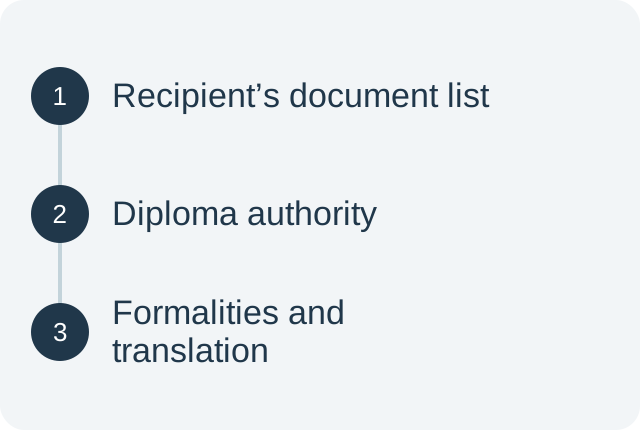
The prior-authentication authority depends on the Belgian diploma and its issuer. Academic recognition and translation still need confirmation from the recipient.
Preparation advice from CertiDocs #
Fictional example: an overseas university requests your Belgian diploma and transcripts. The diploma is bilingual, but an attachment is only in French. Send the complete list to the recipient to confirm which records need translation and which need authentication.
- Keep the originally signed file even when sending a copy for a quote.
- Do not automatically include every transcript: start with the requested list.
Prepare the next step
Documents to prepare
- Institution, community and education level
- Destination-country instructions
- Diploma, transcripts and original signed files
Steps to follow
Get a written list
Ask the recipient about the document, format, language and formalities accepted.
Request the translation you need
Send CertiDocs the complete records, requested language, destination country and instructions received.
Good to know
Guides
On the same topic
Other steps to prepare. Diplomas and equivalence.
Belgian sworn translation for use abroad
Prepare formalities for a Belgian translation used abroad.
eLegalisation: apostille a Belgian document online
Prepare the online application for a document issued in Belgium.
Diploma equivalence in Belgium
Identify the responsible body for your diploma and purpose.
For your application
Budget
Prepare your translation request
Choose the document type in the form to see your fixed price.
One fixed price per complete document, regardless of page count. Confirm the price before submitting. See all prices
Frequently asked questions
+−Must every diploma go through my municipality?
+−My diploma is already in English: do I need a translation?
Official source
Official sources used
The references below are the public sources used to document this page. The competent authority always retains the final decision.
CertiDocs analysis: CertiDocs explains the process and helps connect users with a professional. CertiDocs is not a public service and is not affiliated with any authority.