
CertiDocsThe practical guide
EU record with a multilingual form: translate it?
Before ordering a translation, check whether the authority that issued your record can supply the appropriate European form. This may reduce paperwork and costs.
Understand the processA targeted exemption
Link to this sectionRegulation 2016/1191 covers certain public documents moving between Member States, including birth and marriage records. A diploma or a record issued outside the EU does not automatically qualify. Start by identifying the issuing country and document category.
Keep the record and form together
Link to this sectionThe multilingual form accompanies the record; it does not replace the original. Request it from the competent authority and present both together. Compare names, dates and references to avoid pairing it with a different version. The e-Justice portal lists available forms by country and subject.
When can a translation still be needed?
Link to this sectionThe authority may exceptionally request a certified translation if the record with the form is still not sufficiently understandable. Ask which passage is problematic, such as a marginal annotation. Confirm the scope before ordering: the form must not cause necessary information to be overlooked.
Does the multilingual form cover marginal annotations? #
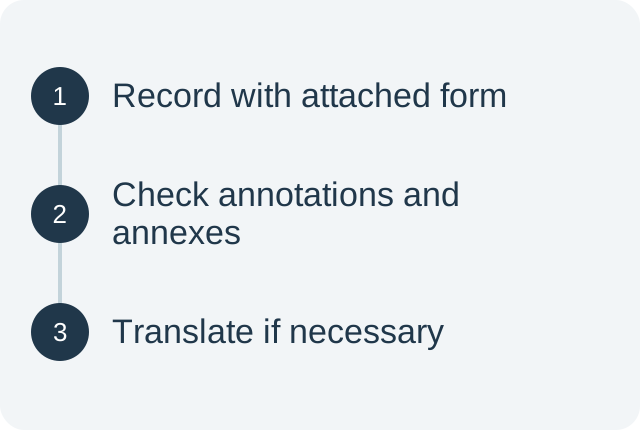
Within the European regulation’s scope, the form accompanies the record as a translation aid. A certified translation may exceptionally be requested if the information is insufficient to understand the record. Account for annotations and attachments too.
Preparation advice from CertiDocs #
Fictional example: a birth certificate has a multilingual form, but a reverse-side annotation is absent from its fields. Show the complete set to the municipality and ask whether translation is still needed and what scope it should cover. Sending only the first page would prevent that check.
- Request the form from the authorised issuer; do not fill it out yourself as an official document.
- Keep the record, form and attachments together.
Prepare the next step
Documents to prepare
- Record issued by an EU Member State
- Official form accompanying that record
- Confirmed language and annotations to be understood
Steps to follow
Ask the issuer
Request the record and form for the Belgian authority.
Translate only if needed
If translation is still required, send CertiDocs the record, form and exact instruction.
Good to know
Guides
On the same topic
Other steps to prepare. Apostille, legalisation and foreign documents.
EU public documents: when an apostille is no longer required
Check whether your record falls within the scope of EU simplifications.
Translation made in France or the EU: valid in Belgium?
Have a translation already made in the EU checked.
Bilingual document and translation in Belgium
Check whether a bilingual document still needs translation.
For your application
Related documents
Common translations
Budget
Prepare your translation request
Choose the document type in the form to see your fixed price.
One fixed price per complete document, regardless of page count. Confirm the price before submitting. See all prices
Frequently asked questions
+−Can I complete the form myself?
+−Does this guarantee recognition of the marriage?
Official source
Official sources used
The references below are the public sources used to document this page. The competent authority always retains the final decision.
CertiDocs analysis: CertiDocs explains the process and helps connect users with a professional. CertiDocs is not a public service and is not affiliated with any authority.