
CertiDocsThe practical guide
Translation made in France or the EU: valid in Belgium?
Check an existing translation before commissioning a second one. The translator’s country, the record’s issuing country and the document type are three separate questions.
Understand the processCheck the European rule
Link to this sectionFor documents covered by Regulation 2016/1191, a certified translation made by a qualified person in one Member State must be accepted in other Member States. This does not automatically validate every translation of every foreign document.
Example: Polish record, French translation, Belgian municipality
Link to this sectionPresent the record and certified translation to the Belgian service, asking it to check the European rules and accepted language. If Dutch is required, a French translation does not meet that language requirement. Conversely, do not commission a replacement merely because the translator practises in another Member State.
A non-EU record translated in the EU is a different case
Link to this sectionThe place of translation does not change the record’s issuing country. For an Algerian, Moroccan or other non-EU record, check the original’s authentication and acceptance of its translation in the relevant procedure. A translator being based in France does not itself create an apostille exemption.
If the authority rejects the translation
Link to this sectionAsk for the exact reason: language, translator’s qualification, missing document, incomplete content or a formality affecting the original. Keep the response and share it with the professional. A new translation helps when it addresses the identified problem; it will not fix an unsuitable source record.
French certified translation rejected: start again? #
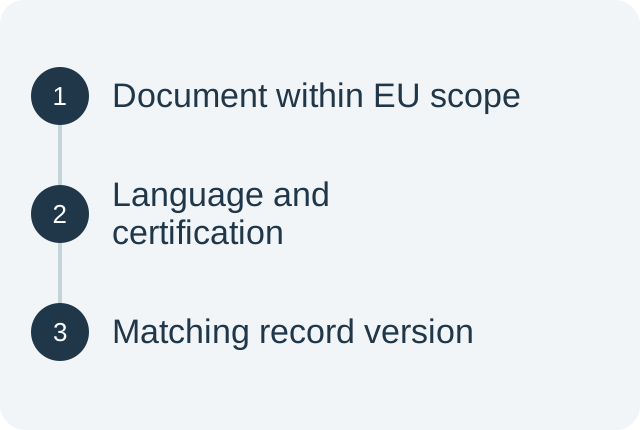
For public documents covered by the European regulation, member states must accept certified translations made by a qualified person in another member state. Still check the accepted language, translator’s qualification and correspondence with the supplied record.
Preparation advice from CertiDocs #
Fictional example: your translation covers an older record, while the new copy contains an extra annotation. Ask whether the refusal concerns this mismatch, language or certification. Send the answer and both versions to the professional. Depending on the confirmed scope, an update may be appropriate; avoid ordering before identifying the issue.
- Ask for the precise reason in writing to prepare a response with the service or adviser.
- A reusable translation must still match the correct source-document version.
Prepare the next step
Documents to prepare
- Issuing country and record category
- Authorised translator and complete translation
- Accepted language and exact reason for any rejection
Steps to follow
Have the existing documents checked
Present the record, translation and recipient’s instructions together.
Request translation if still needed
If confirmed, tell CertiDocs the language, pages and reason for the request.
Good to know
Guides
On the same topic
Other steps to prepare. Apostille, legalisation and foreign documents.
EU public documents: when an apostille is no longer required
Check whether your record falls within the scope of EU simplifications.
EU record with a multilingual form: translate it?
Check whether an official form can avoid translation.
Sworn translation refused in Belgium
Identify the refusal reason before having the translation corrected or redone.
For your application
Related documents
Common translations
Budget
Prepare your translation request
Choose the document type in the form to see your fixed price.
One fixed price per complete document, regardless of page count. Confirm the price before submitting. See all prices
Frequently asked questions
+−Is a Belgian VTI number always required?
+−Does the rule cover all diplomas?
Official source
Official sources used
The references below are the public sources used to document this page. The competent authority always retains the final decision.
CertiDocs analysis: CertiDocs explains the process and helps connect users with a professional. CertiDocs is not a public service and is not affiliated with any authority.